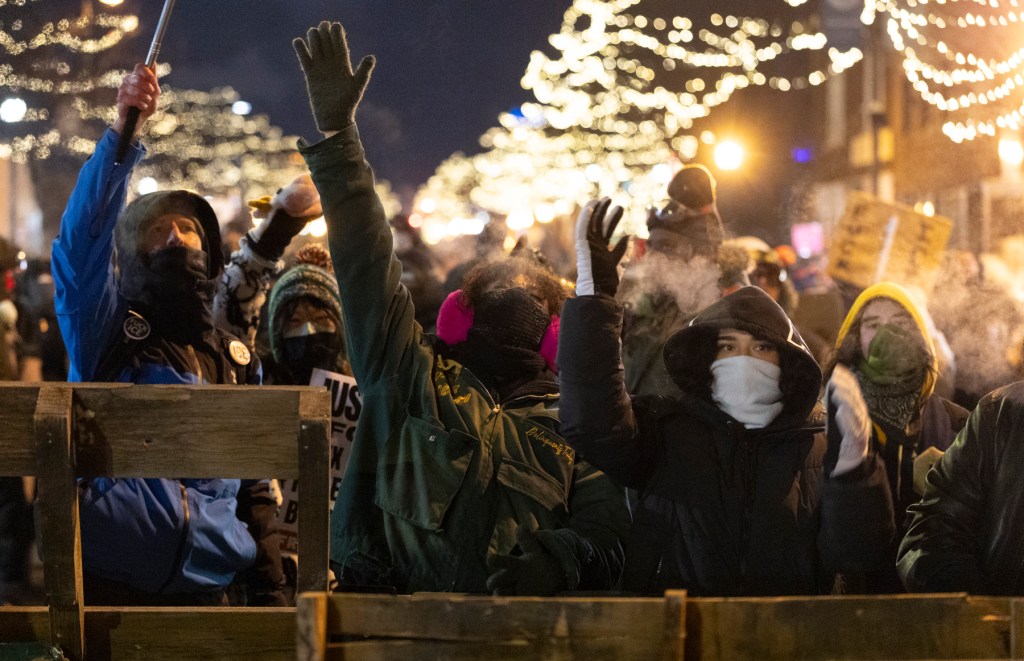


Minneapolis educators could strike as soon as November, the union announced Friday.
The Minneapolis Federation of Educators, which represents K-12 teachers, paraprofessionals, and adult educators, announced that it would hold a strike authorization vote Oct. 23, 24, and 27, unless the union and district reach an agreement during the next mediation session on Oct. 21. If educators authorize a strike, they must give the district at least 10 days notice of a strike date.
Minneapolis Public Schools said in a written statement that it hoped to reach an agreement with the union “as quickly as possible so that we can collectively focus on providing the best possible learning environment for our students.”
“While the district’s budget is tighter than ever due to the historic underfunding of public education and expenses outpacing our revenue, we hope to reach an agreement that is fair, student-centered, and ensures the district can thrive even if there are state and federal funding cuts,” the district said.
Marcia Howard, the president of the union’s teacher chapter, told Sahan Journal she had hoped to set a new tone in the union’s sometimes contentious relationship with the district by attempting to settle the contract quietly.
“And yet that has not given us dividends as it relates to the district giving the parents what it is they’re asking for, which is enforceable class size caps,” she said.
The district and union agreed on contractual class size caps following a three-week teacher strike in March 2022. But loopholes in that language gave the district the right to exceed class size caps, by finding alternative solutions or paying the teacher an additional $500 per student.
A Sahan Journal analysis found that in the fall of 2024, one in five elementary classrooms exceeded its class size cap.
The district said that in recent mediation sessions, it had brought forward “a significant investment to reduce class sizes.”
During an Oct. 14 school board meeting, several parents from the advocacy group Minneapolis Families for Public Schools called for lower class sizes.
Shannon Gibney, whose son attends South High School, said large class sizes were making it difficult for her son and his classmates to learn, including in a machine shop class. In that class, “there is a real need to get the teacher’s attention or there are real safety issues at hand,” Gibney said.
One of her son’s classmates has dyslexia and relies on voice-to-text technology for writing, she said. But if the class is too large and loud, he isn’t able to use the technology he needs.
Christian Glanville, whose son attends kindergarten at Waite Park Elementary School, described safety concerns resulting from large class sizes. Waite Park was on lockdown for a week shortly after the school year began, when a Missouri man threatened to shoot up the school. The threat came on the heels of the deadly school shooting that killed two Annunciation Catholic School students and injured 28 other children and adults.
“His classroom has massive sunny windows, something I’m usually grateful for, but 60 kindergartners in two highly visible rooms is too much for two educators to protect,” Glanville said.
While a third teacher has since been added, he said, many other Waite Park classrooms were still too crowded.
“You cannot pass gun reform laws,” he told the school board. “However, you can directly make education safer by ensuring that no classroom is unmanageable by volume in the event of an emergency.”
Educators are also calling for limits on special education caseloads, as well as increased pay for educational support professionals, adult educators, and K-12 teachers. Howard said the district had not offered any pay increases to teachers or educational support professionals.
Kim Ambers, an educational support professional at Lucy Craft Laney Elementary School, asked the district at the Oct. 14 school board meeting to work with the union.
“Being an educational support professional, ESP in short, is a career for some staff, including me. It’s not a drive-by job. We are dedicated to the students we serve,” she said, noting she had worked for the district for 33 years. “ESP deserve a livable wage.”
The announcement of a strike authorization vote comes as Minneapolis Public Schools, which has faced steep budget cuts in recent years, deliberates whether to close, consolidate, or repurpose some school buildings. A report outlining costs and benefits of possible closings and consolidations is expected by the end of April.
The timeline for the report on possible school closures and consolidations has been updated in this story.


