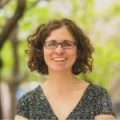
As students filed into Annie Connor’s third-hour class at Andersen United Middle School, she offered them directions in Spanish: “Encuentra tu calabaza!” Find your pumpkin!
The sixth- to eighth-grade students, all of whom have been in the country for less than a year, had spent their first seven weeks in Connor’s class learning the basics of American middle school. Now, they were beginning their first project. Each student would paint a pumpkin, and deliver it, with a card of appreciation to a school staffer.
Andersen is home to Minneapolis Public Schools’ Spanish dual-language middle school program, as well as a mainstream English middle school track. The school is also home to a growing population of new immigrant students, many from Spanish speaking countries. Many of the new students enroll in the Spanish dual-language program, but when those classes fill up, they take classes in English.
Minneapolis Public Schools has seen a significant increase in new immigrant students over the last several years, fueled by immigration from Latin America. The district reported more than 2,500 new Spanish-speaking students who enrolled between January 2023 and January 2024. Some district officials have expressed hope that the new students can help stabilize the district’s enrollment, which has fallen in recent years. Others note that the state does not adequately fund programs for English language learners, and say the new students may not help the district with its budget woes.
Many of the new students have landed at Andersen. As of the first day of school, 300 of Andersen’s 1,000 students had arrived in the country in the last three years. Many of those students came from Ecuador as well as Mexico, Guatemala, and Honduras; smaller but growing numbers of students come from Afghanistan, Turkey, and Somalia. So far this school year, Andersen has welcomed several new immigrant students every week — and Connor has been there to orient them.
Previously, Connor was the school’s lead English as a second language teacher, supporting and coaching other teachers. But since last school year, she’s shifted to a role focused on supporting newcomer students. That includes classes dedicated to orienting newcomers to the basics of middle school in the United States: attendance, grades, the computer portal, and school rules.
Connor also helps students enroll in classes that are the best fit for them. If a spot opens up in the Spanish dual-language program, she helps them grab it. And she tries to encourage families to enroll students in a grade level that matches their age. She’s noticed some students who have spent time in New York City Public Schools may be in a different grade level than Minneapolis Public Schools would assign them; it’s not uncommon to see 12-year-olds in eighth grade, though if they arrived first in Minneapolis, those students would likely be enrolled in seventh grade. (In a statement, New York schools spokesperson Nicole Brownstein said the district enrolls students based on age and available academic records, and makes adjustments as necessary.)
One school rule Connor makes sure to highlight centers on Carnaval, after some incidents last school year. Though in Ecuador it may be common practice to smash raw eggs on classmates’ heads and then sprinkle them with flour during the pre-Lenten celebration, she explains that this practice is frowned upon in American schools.
Before this class existed, Connor recalled playing “whack-a-mole” with newcomers’ needs, addressing questions like these after a problem arose, rather than proactively teaching them in advance. Now, her classroom has become a “home base” for students who are new to the country — dealing with not only the regular mental health and social struggles of middle school but also the challenges of moving to a new country and the trauma of an immigration journey.
Connor encourages them to bring a mental “shovel” and dig deep into hard questions to practice critical thinking skills. And after class, she supports them with schedule confusion, bus route changes, or mental health problems (when she calls in a Spanish-speaking school social worker).
“When there’s a big problem that they don’t know how to fix, they’ll be here at my door,” she said. “I think it’s just a direct person to cut through the complexity of systems. And I hope that it gives them a space to navigate their first year.”

Practicing creativity and gratitude
Connor, wearing a Peanuts Halloween sweatshirt that had belonged to her grandmother, distributed small trays of paints to her students.
Kevin, at 14 the oldest student in the mixed-grade class, painted his pumpkin black and began to etch out small PacMan-shaped ghosts by scratching paint away. He said he planned to give his pumpkin to his ESL teacher, Cynthia Shaffner.
“Thanks to her, I’m more or less learning English,” he said in Spanish.
Throughout the classroom, students took advantage of the opportunity to express their creativity. Camila mixed different blues to create a spooky moon. Yosi cut a pirate hat and sword out of construction paper for her pirate pumpkin. Ivan painted his pumpkin to look like Jack in “The Nightmare Before Christmas.”
Mayde, a 12-year-old student from Costa Rica, painted her pumpkin black as a backdrop and added a white heart on top. She planned to give her pumpkin to Grace Leierwood, a school social worker who she said helped her with “emotional problems,” though she had also written cards to several other teachers. But Mayde didn’t like the way her heart looked. “Horrible!” she said. “I’m a perfectionist,” she added in Spanish.

After class, Connor helped a new student resolve an issue with her bus route, and then sorted through the students’ cards to teachers. She noted the variety of Andersen adults that students had chosen for their cards: a staffer from Check and Connect who calls students with frequent absences, math and science teachers who only speak English, behavior deans. One student who can’t read dictated his note to another student, then copied what she had written so it would be in his handwriting. Another student thanked a behavior dean for taking away his cell phone twice, and said he no longer brings it to school.
A week later, on Halloween, a few students put final touches on their pumpkins. A group of five girls set out to deliver pumpkins and cards to their English teacher, Connie Salazar. Since Salazar’s favorite color is pink, some of the students had painted their pumpkins pink or chosen pink cards for her. And Halloween also marked Salazar’s birthday.
After some discussion, the girls decided to sing “Happy Birthday” to her in English, rather than Spanish, and surprised their teacher, who wore a pink cowboy hat, at her classroom door.

“Thank you so much!” said Salazar. “You did this?” she asked them, looking at their pumpkins and cards.
“Don’t cry, teacher,” Mayde said in Spanish, and they laughed.
“I was really surprised and heartwarmed,” Salazar said later. She explained that she had moved to Minneapolis a year ago from Chile, and this was her first time celebrating her birthday away from her family.
“I have mixed emotions, and it’s hard, but they make it feel better,” she said. “It’s nice to feel that they can trust someone. And they can relate to me, because we come from the same type of culture.”
For Connor, the activity had many purposes: allowing students to express themselves without language; using the brainstorming process; developing an idea, executing it, and troubleshooting any difficulties along the way. And it’s an opportunity for them to learn about an American holiday, and try candy corn and apple cider for the first time.
But in the end, she said, it came back to the idea of community — and helping the students establish a firmer home base.
“The act of creating something for somebody else is about community,” she said. “I think the act of expressing yourself is about exploring who you are, but it’s also exploring who you are in the context of a community. Because your community has now changed.”