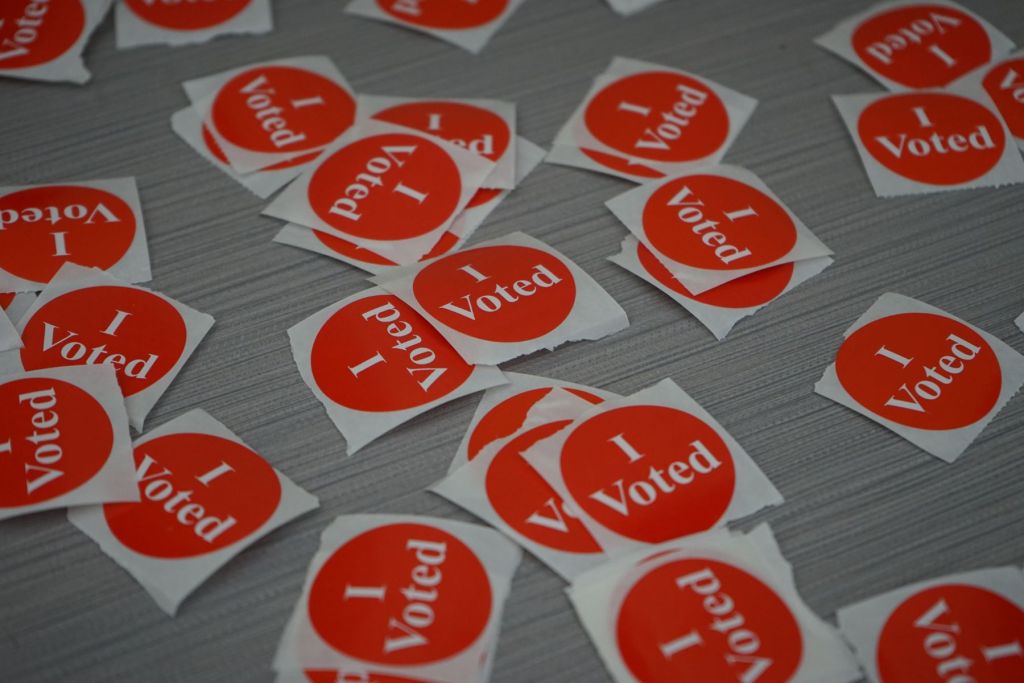

On a rainy, cold Tuesday, Jolene Jones and her team of volunteers stood under a canopy outside Little Earth, the Native-preference housing complex in south Minneapolis. Inside, an early-voting pop-up was taking place.
“Did you vote yet, my girl?” Jones asked a passerby. “Our votes are important; we really need our people.”
Despite the rain, turnout was better than expected. Armed with free posters, yard signs and T-shirts as well as hot chocolate, coffee and tea, Jones and the volunteers were rallying Little Earth residents to get their vote in early.
Jones, a lifelong Little Earth resident, is the manager at Make Voting a Tradition (MVAT), an initiative by the Native American Community Development Institute (NACDI) that works towards increasing Native voter turnout and civic engagement.
Since its advent in 2014, MVAT has helped move the needle on Native voter participation, Jones said.
But this year feels more urgent, she said.

On Monday evening, MVAT hosted another event at the Minneapolis American Indian Center with art, music and short films to get people excited to vote and vote early.
At center stage was opposition to Operation Metro Surge and its impact on the Native community. Native American rapper Tall Paul performed, and spoke about federal agents targeting Native people, including his wife, who had been followed in her car.
While performers and speakers took stage at the atrium of the Indian Center, two short films which highlighted Native American resistance to ICE along with Native rights as citizens and tribal members played in a loop in a room: ‘We Remain Sovereign’, and ‘Ikogaan Mikwan!’ which means “ICE OUT” in Ojibwe.
“It is absolutely important for us to vote, always, but it’s a little different this year because of Operation Metro Surge, [and] the way that Native people were impacted by a government agency that is not supposed to attack us, but it did,” Paul told Sahan Journal.
There was also excitement about Lt. Gov. Peggy Flanagan’s U.S. Senate run, and increased enthusiasm from Native youth not only to vote themselves, but to rally their friends and family, too.
“What [the community] does feel empowered by is the fact that they are looking out for their neighbors. They are making active choices. They’re being engaged in both the political sense, but also in the local sense,” said Em Matson, communications manager with NACDI.
MVAT was encouraging people to vote early so they can monitor polling stations on Election Day, or help their neighbors reach polling stations.

Maya Jade Stand-Acero turned 18 in January and voted for the first time in the August primary. For her, too, Operation Metro Surge’s impact hit close to home; she was scared for her father, who was naturalized as a citizen only in February.
“It clicked in my head, ‘This is reality; this is not fake. This is not TV.’ We’ve got to get out there and vote,” she said. Stand-Acero, a community specialist with NACDI, said she wants to be a social worker, but more importantly, she wants to be a good neighbor. “People were scared, and being a good neighbor was checking up on my people, going to my Latino friends like, ‘Hey, are you good? Do you need anything?’ ”
Native voter participation continues to be a challenge, given a historic lack of trust in the federal government, and a belief that Native votes don’t matter, said Jamie Edwards, senior adviser of government affairs for the Mille Lacs Band of Ojibwe.
“If there was ever a time to double down and exercise your civil rights and get involved in politics, it is now, so that democracy isn’t destroyed,” Edwards said.

Native Americans were granted the right to vote only in 1924 with the passing of the Indian Citizenship Act. Even then, they were often prevented from participating in elections because states decide who has the right to vote.
The Minnesota Secretary of State’s office does not collect data on voters’ race or ethnicity, so there is no state data on Native American participation in voting.
MVAT collects its own data. In a 2023 survey asking Native Americans why they vote, 766 respondents said voting represents a pathway to change and a way to honor family traditions and stand up for Native communities.
They also feel burdened by systemic barriers or disillusioned by a lack of trust in political institutions. Many also don’t see themselves represented in the leaders running for office, Matson said.
A 2024 MVAT survey found that of the 448 people surveyed in the Twin Cities and in some northern Minnesota reservations, over half said they voted, driven by issues including women’s rights, climate change, tribal sovereignty, democracy and anti-Trump sentiment, among others.
MVAT’s early-voting efforts have borne fruit. Michelle White, also a Little Earth resident, said she missed out on voting during the primaries because she couldn’t make it to the polling station on Election Day. This year, she voted early and said she will urge her sons, ages 18 and 25, to vote early, too.
For Jacqueline Neadeau, protecting the Boundary Waters, stopping data centers and ensuring the safety of the waters and environmental concerns in general were top of mind as she voted this week. “It feels good even seeing the younger ones and they’re voting,” she said. “I wish my kids would get over here and vote for the right people and save our land and water.”
Rebecca Skinaway didn’t grow up having conversations about voting. She voted for the first time during the most recent presidential election, persuaded by MVAT and with the help of a friend who drove her to the polling station. For her, the homelessness crisis and drug use in the neighborhood are top of mind as she cast her ballot.
“My daughter is 6. These are the next generations, and we’ve got to think about them, about their futures. We’ve got to pave the way, and show them,” Skinaway said.