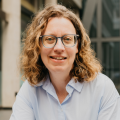
Lacy Armstrong, 37
Recovery and Treatment Coordinator at White Earth Substance Abuse Program
Doula-in-training
Mother of four
Home town: Mahnomen
Tribal affiliation: Leech Lake Band of Ojibwe
Nine years of sobriety
Looking back on it, Lacy Armstrong says, a successful life path was right in front of her.
She wears a “We Recover” T-shirt over a traditional floral ribbon skirt, with earrings in the shape of flowers and bright lipstick. Her braid reaches to her waist, and she is quick to smile.
After graduating from Bagley High School, Armstrong followed her passion for singing and music to Northland Community and Technical College, in Thief River Falls. She earned a degree in audio production from the Minnesota School of Business, in Waite Park.
But in that year after college, away from home, she floundered. She moved to St. Paul to look for a job in 2009, but instead found a boyfriend who used prescription opioids. He took her to parties where Percocet rivaled alcohol as the substance of choice.
“I’m book smart and street smart,” she jokes. “I graduated college — damn, you did the four-year college thing — but then I learned the drug trade right after that. You’re supposed to get a good job, good career…but I’m really well-rounded.”
Armstrong moved back to the White Earth Reservation at the end of 2010 and managed to stop using heroin.
That summer, her partner died from an overdose. Four months later, she discovered that she was four months pregnant.
After giving birth to a daughter, things were good for about 18 months. Then she started another relationship with someone who used hard drugs. When he, too, died of an overdose, she spiraled. Desperate to get clean, she made it only four days after the funeral before she started using again. Not knowing how to cope with her grief, she spent time in and out of jail, where she was put on suicide watch, and on and off the streets. Her parents took care of her daughter.
In 2014, Armstrong was civilly committed — a step in which the state compels someone to seek treatment —and sent to Brainerd Four Winds Lodge, a culture-based sobriety program without medication. While she was there, she received her spirit name — a tradition in which an elder confers a name that speaks to the person’s character — at her first sweat lodge ceremony. It was, she says, a spiritual awakening.
But she was home for just a few days before she ran into someone who she knew sold drugs.
“And that was my relapse,” she says.
After another failed drug test, she was given two options: Go back to inpatient treatment without her family, or try the new MOMS program at White Earth.
“I was the No. 2 client and I was scared,” she says. But the staff did not judge her; she immediately felt comfortable sharing her story.
Her partner at the time, Donovan Burnette, was one of the first men to join MOMS.
“I don’t think I would be here today without this program,” Burnette said. (They’ve since broken up, but remain in touch.) “Look at how many parents this program gave back to the kids.”
Armstrong also started learning more about the connection between historical trauma and addiction. Growing up, she hadn’t known that Native Americans traditionally didn’t use substances or alcohol, she says.
She grew increasingly interested in the history of trauma and Native Americans. She learned about many factors that contributed to the drug epidemic among Native people. European colonization and the disastrous introduction of alcohol into Native communities. Boarding schools that separated Native children separated from their parents. And child-welfare policies that destroyed Native families.
“It wasn’t just a few people here and there, it was a lot of people losing kids,” Armstrong said.
“I know that my journey was affected deeply by the historical trauma of our people, the loss of our life ways.”
Armstrong has been sober since Sept. 2, 2015. That same year, she regained custody of her daughter and gave birth to a son. Today, she works as the administrative assistant for the cultural program at MOMS.
“I will always aim to uplift and break cycles for my children, the people that I have affected during my addiction, our ancestors, before and after,” she says. “I live my life in a good way to honor them and to honor my children and myself.”


The series is part of a reporting fellowship sponsored by the Association of Health Care Journalists and supported by The Commonwealth Fund.