


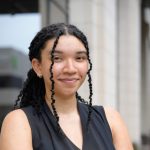

“We are keepers of our stories,” writes Hopi artist Mikaela Shafer in a poem featured in her solo show at All My Relations Arts. “Matrilineal memories. I want my daughters to tell stories of love, of resilience. I am rewriting our tales for tomorrow.”
This weekend, that spirit of storytelling echoes across the Twin Cities. Shafer’s work traces grief, memory and ancestral strength in Minneapolis, while author Kao Kalia Yang carries the experiences of her Hmong refugee family forward in St. Paul. At the Weisman Art Museum, rugs from Lebanese, Afro-Caribbean, Chinese and Ukrainian artists thread stories of heritage, resilience and cultural survival.

Watercolors and poetry reach for ancestral memory
All My Relations Arts on Franklin Avenue feels more like a home than a gallery. The smell of coffee drifts in from Pow Wow Grounds next door, conversations spill between rooms and the soft shimmer of chiffon hangs from the ceiling for “Matrilineal Memory,” a new solo show by artist Mikaela Shafer honoring her Hopi culture.
Shafer’s work combines abstract watercolors with found materials, including coffee paper, gauze, kombucha leather, and fallen leaves, alongside poetry. She traces how grief and ancestral memory are carried, processed and passed down through generations.
Beside her piece “The Salmon Are Coming Home,” she writes: “I hope you understand that my rage is not my own. My blood is ancestral. My screams are generations. I came out of the womb ready to resist. And my fists are tight from decades of lost fights.”
Her installation “Memory Is Ephemeral” centers on an antique bedframe sprouting with leafless branches and crafted butterflies. Photographs of Shafer free-falling hang above the bed across multiple layers, so her body shifts and floats depending on where viewers stand. Light passes through the sheer material, giving her a translucent, ethereal presence.
Across from the bed, a video projection shows Shafer sewing pieces together in an open, expansive field.
The gallery has become a space for experimentation and risk, where Native artists can show new work and push boundaries. Angela Two Stars, director and vice president of arts and culture at All My Relations Arts, experienced that firsthand when she first exhibited her own work at the gallery in 2016.
“It was an exhibition called ‘On Burrowed Ground.’ I was living in Michigan and drove nine hours to the opening because it was that important to me,” Two Stars said.
She later returned to curate an exhibit on missing and murdered Indigenous women before taking on her current leadership role.
“This art is a reflection of our people,” she said. “When people come in to see the exhibitions, they can relate to it because they understand what the artists are saying, the symbols they’re using, and the stories and songs that the artists incorporate into their work. I’ve seen people point to a mural we’ve had on the wall and say, ‘That’s home right there.’”
Two Stars noted that changes to the neighborhood, including fences installed to prevent homeless encampments have reshaped the neighborhood’s perception.
“When I first came back home in 2017, I turned onto Franklin Avenue and saw beautiful murals that looked like a regalia,” she said. “It made me feel welcome like, here’s where my people are. Now when I turn on Franklin, I see fences and it makes me feel like it’s harmful to the land, which hurts me to see.”
Through her work at All My Relations Arts, she hopes that the American Indian Cultural Corridor in Minneapolis will be defined by artists like Shafer rather than barriers.
“I’d like to see a sculpture park,” she said. “Art drives out negative traffic. It gives opportunities for artists to show their work and it helps people feel that same sense of welcome I felt.”
Date: Through Dec. 13.
Time: 10 a.m. to 5 p.m. Tuesday through Friday. Noon to 3 p.m. on Saturday.
Location: All My Relations Arts, 1414 E. Franklin Ave., Minneapolis
Cost: Free
For more information: Visit allmyrelationsarts.org/exhibitions-events/exhibitions/matrilineal-memory/

Rugs you can’t put your shoes on
In “RugLife” at the Weisman Art Museum, thirteen artists turn rugs into sites of culture and resistance. Afro-Caribbean artist Sonya Clark weaves a carpet from combs, honoring Black hair and heritage. Chinese artist Ai Weiwei’s “Tyger” reworks traditional Tibetan tiger rugs to confront human exploitation of the natural world. Ukrainian artist Oksana Levchenya’s “Pac Man and Cossacks” threads video-game pixels through history, with Pac-Man’s relentless quest to consume reflecting the enduring cycles of conflict and the fight for independence in Ukraine. Ali Cha’aban wraps a plastic refugee-camp chair in a Persian rug to highlight the persistence of cultural tradition even in displacement.
Date: Through Dec. 28
Time: 10 a.m. to 5 p.m. Wednesday through Friday. 11 a.m. to 5 p.m. Saturday and Sunday.
Location: Weisman Art Museum, 333 E. River Road, Minneapolis
Cost: Free
For more information: Visit wam.umn.edu/ruglife

Kao Kalia Yang shares refugee stories in St. Paul
Born in a refugee camp and raised on St. Paul’s East Side, author Kao Kalia Yang writes with intimacy about home, exile, and the strength that carried her family and refugee communities through displacement. On Friday’s author talk event, Yang will read from her work, which spans memoir and children’s literature. Her latest memoir, “Where Rivers Part: A Story of My Mother’s Life” follows her mother’s harrowing journey from war-torn Laos to the United States, while her children’s book “The Rock in My Throat” explores Yang’s own experiences growing up as a Hmong refugee navigating life at home and at school. During the event, she will also share insights on literacy and strategies for educators supporting children from refugee backgrounds.
Date: Friday, Oct. 24
Time: 9:15 a.m. to 12 p.m.
Location: East Side Learning Center, 290 Arundel St., St. Paul
Cost: Free
For more information: Visit eventbrite.com/e/kao-kalia-yang-author-talk-tickets-1669118742089


