



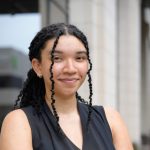

When you first meet Obi Original, it’s impossible not to feel his infectious energy.
Wearing a tie-dye Bob Marley t-shirt and holding the guitar his mother bought him when he was 7, he finger-picks a few notes and hums along, explaining that he always begins with a melody. He trusts that the words will arrive when they need to.
He speaks as if you’ve known each other for years. He tells you stories with a reverence for his Nigerian culture, braiding personal experience with the lives of those who came before him. There is a buoyancy to him, tempered by knowing that highlife music carries the resilience of his people. He plays it so that you might remember too.
On stage, the energy only grows. His band, The Black Atlantics, follow him into the grooves of Nigerian highlife: guitar, piano and percussion move together, while his voice threads through it.
It’s the kind of presence that Bakarii, a musician who would later form Ozone Creations with Obi, remembers from their first meeting. Obi was a “really exuberant, fun-loving, loud dude,” who was mainly known as a producer when they crossed paths at a 2018 video shoot for Breezy (Too Fresh), another member of Ozone Creations.
Not long after, the three found themselves making music late into the night, and that’s when they realized that Obi’s talent didn’t stop at production.
“Me, Breezy and Obi were in a room together at my house just making music together freely with no concept of time,” Bakarii said. “Breezy was like, ‘Obi, the stuff you’re suggesting in these studio sessions — your producer brain is very top tier. But you should also consider what you can provide as an artist.’”
Obiora Obikwelu (Obi’s given name) has always lived between two worlds. Born in Minnesota in 1995, he spent his earliest years in Lagos before moving back to Minnesota when he was 5. Still, he returned to Nigeria every summer until 2020. His music does the same. It is rooted in Igbo highlife, yet shaped by the hip-hop and R&B traditions that pulse through the Twin Cities.
RELATED STORIES
That duality has carried him to big stages. He’s hosted dance parties at First Avenue, performed at the Minnesota State Fair, opened for Ghanaian-Australian rapper Genesis Owusu, and toured with Cameroonian-American singer Libianca alongside Alicia Keys — introducing Afrobeats to audiences who may never have encountered it before.
“You see a crowd full of middle-aged white people who’ve never heard Fela Kuti before or African highlife music, and then you see them tapping their feet, nodding their heads, some of them fully just letting loose and dancing,” Bakarii said. “That’s his whole goal is to show people what this music can really do.”
Now, Obi is preparing to release his first studio album, “From Dusk Till Grace,” this November. The six-track project, recorded live with The Black Atlantics, aims to bring the sounds of highlife to Minnesota’s mainstream.
In an interview with Sahan Journal, Obi reflected on his early exposure to highlife, the creation of Ozone Creations, the making of their sophomore album “Free Therapy,” and his mission as an artist.
The interview has been edited for length and clarity.

When did you first fall in love with music? Was there a particular moment when you thought, ‘this is what I’m meant to do’?
Growing up in my household, my mom and dad had a lot of old Nigerian highlife and Afrobeat records, so my dad would play Osita Osadebe, one of his popular records, and I just remember being young and thinking, ‘How can music make me release all my stress and make me feel at peace?’ Don’t get me wrong, I was a kid. There was not a lot of stress, but music had that capability and I think that was the first time I realized what the music of my people can do and what music can do for people.
I started with playing guitar. Actually, I have it with me. It’s a Lyon Washburn. It’s like the cheapest guitar you could buy from Target in 2000– dang, I’m old. 2007. We lived in an apartment, so I couldn’t really buy a big piano or anything, so my mom got this for me and noticed that I really loved music. I would play with the tunes that I’d hear at my house and add my own flavor as if I was a guitarist on the album.
Were your parents creative?
I’m the only person in my immediate family that gravitated towards creativity and art. My dad is a retired teacher from Minnesota Transition School and my mom is a retired nurse, so they both worked very hard to make sure that I had a comfortable life. One thing that they always said collectively was: this next generation has to be able to do something in this world based on their own merit versus working for somebody else. So, I’m grateful I was able to find that path for myself.
What part of Nigeria are you from?
I’m from southeast Nigeria. From the Igbo tribe. We have three major tribes in Nigeria: Igbo, Hausa and Yoruba but with the Igbo tribe, we gravitate towards the type of music we call highlife music. Yoruba people usually have their traditional music that is termed as Jùjú or Fuji music but highlife has a certain cadence.
As an Igbo person, I give a lot of credit to Ghana because Ghana is like the forefather of highlife. They made that genre before the independence of a lot of African countries. But at the time, a lot of the studios in Sub-Saharan Africa were in Nigeria. So, you have people from Ghana who come to Nigeria, share their rhythms, and before you know it, it becomes embedded into our traditional sounds and modern culture.

What drew you to highlife music?
Highlife music in Nigeria puts you at a higher state of mind. Even if it’s like, ‘Damn, I’m so sad. I don’t know what to do.’ If you’re able to put on a highlife track, you’ll be able to find at least one or two ways to get out of your situation and ease the mind.
Don’t get me wrong, reggae and soft rock is really great music, but I knew I needed to share this with my community because, especially with everything that’s happened in the past decade with social justice, it is essential for people to learn about Africa. I will make sure that people know and learn about it. I will bridge that gap between African Americans and Africans because our parents have gone through that and I refuse for this generation to do the same. We need to move forward. That is the power of my music.
As an Igbo man, I have to preserve my culture and I want to be able to unapologetically share my culture with people that have no idea about it through music. I don’t have a chalkboard. I have my guitar and I write with that. Class is in session anytime people come and see me perform, you understand? People have homework in life.
How was Ozone Creations formed?
At the beginning of my college career and at the end of 2019, I was introduced to Bakarii and Sumer. I grew up with Mack OC. I remember when he was born. So it’s been a magical journey to see him grow. Breezy and I have been friends since we were kids. His mom and my mom were bridesmaids at each other’s weddings. Chinwe went to the same high school as me but he was a lacrosse dude. We weren’t really in each other’s circle until he saw what I was doing and he took interest in working with me and learning from me.
Sumer is unapologetically amazing when it comes to her consistency on social media. If I’m slacking she’ll be like ‘Obi, you have not posted enough. You need to have more content.’ Yes, sis. ‘Obi, this outfit is not giving.’ Yes, sis.
And make sure you put this in the article — Bakarii Jackson is the Smokey Robinson of the city. A lot of people don’t know Smokey was the vice president of Motown and I think when they say history repeats itself in a positive way, Bakarii is part of that tradition. Breezy is an amazing wordsmith that inspired me to make sure my pen is sharp, especially when I’m writing my highlife music. I got that from Breezy and Mack.

How would you describe the sounds and themes of Ozone Creations’ new record “Free Therapy”?
Therapy is something that is overlooked in circles, especially with Black men and the BIPOC community. We glorify so many things in our community but when it comes to mental health that is now the bottom of the barrel. With this album, we really wanted to make it the first priority. We wanted to make it the umbrella for people to be under when the rain of life is falling down.
Our first album, “Coup D’etat” was one of the best mixtapes to come out of the city. I love that album but it was a mixtape of our best songs put together and as a group. We said our next album would make more sense from one song to the other. Big shout out to Sumer who came to the group with the concept, especially with her starting to go to therapy.
Across your work with the collective and your band, The Black Atlantics, what is most important for you to convey through your music?
As an artist, I think it’s our duty to understand that for us to be in a symbiotic relationship with our community, we cannot come first. And I get when artists say ‘ It comes from my mind, it comes from my experiences,’ but I always ask the question, ‘ Are you singing to yourself or are you singing to us?’ Some artists say ‘Well, yeah, it’s just for me.’ That is very selfish. It is for you to be a vessel for the world around you and know how to curate it properly to feed the people. It’s not for us to bask in our glory. I make music that will inspire somebody going to work at Caribou. I make music for people to listen to before they go to their court case. I make music for the traders and workers in Lagos, Nigeria. That’s who I’m making music for.


