
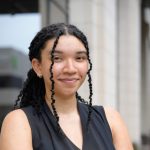

Writer, filmmaker and performance artist Junauda Petrus opened her two-year term as Minneapolis’ new poet laureate with a love letter to her hometown.
In her poem, “Ritual on How to Love Minneapolis Again,” read during her official announcement on Jan. 30, Petrus spoke of shared meals in immigrant neighborhoods, Native drums at school assemblies, henna and silk dresses at Somali weddings, and the “funk of blunt guts” on the Route 5 bus, where Black girls whisper and giggle in bonnets and slippers.
“I was riding the 5 bus a lot. If you’re from south Minneapolis or the North Side, there’s just something about that 5. Like, this is Minneapolis,” Petrus said. “It’s like being in love where I just want to tell you all the sweet things. I just want to make you understand it.”
Her poem highlights both the disparities and vibrancy of the city. It acknowledges the effects of historic redlining and housing insecurity within communities of color, while celebrating the joy that emerges from cultural resilience — like immigrant families adapting to Minnesota winters or the ties between the Mississippi River and rivers in Africa and Southeast Asia.
Her work traces the migration of people and memory, connecting Minneapolis to the ancestral homelands of Black, Indigenous and immigrant communities. There is grief in the poem, but also joy. The kind of joy that comes from knowing her birth place intimately.
Petrus, 43, applied for the poet laureate position in 2023, but Ojibwe writer Heid E. Erdrich was chosen to be the first to hold the title. For Petrus, Erdrich’s leadership set a strong foundation for what the role could be.
“It was nice getting to connect with Heid because she told me how, during the first couple of months, she went and saw a lot of poetry, and I really appreciate that,” Petrus said. “It’s not just, about ‘What am I doing with the poetry?’ but to cheerlead poets. That’s also part of my job — to bless up poetry and be blessed by poetry.”
When she received the call from the Loft Literary Center informing her that she had been selected as the city’s second poet laureate, Petrus was at home with her wife and daughter. She held onto the news for a month before it was publicly announced.
“It really showed me the kind of artist, the poet I’ve been and the community member I’ve been,” she said. “Especially with all that’s going on, it felt like a particular positive light for people at this moment.”
As poet laureate, Petrus will receive an honorarium of $16,000, paid quarterly over her two-year tenure, along with a $4,000 budget to plan and execute a project aimed at engaging youth or addressing important community issues through poetry. Her key responsibilities include hosting public poetry events and teaching two classes per year through the Loft Literary Center.
Where the magic is
Petrus, who grew up in the Phillips neighborhood, is the daughter of Caribbean immigrant parents. Her mother from Trinidad and her father from the U.S. Virgin Islands.
Her mother, a chef who ran pop-up restaurants and catered in Minneapolis, taught her that food, like language, carries memory.
“I think I love food because of my Caribbean culture,” Petrus said. “For a lot of people who are first generation, if you can’t share the language, it’s the food. So, I really learned Trinidad through my mom’s curries and stews.”
Her writing is influenced by reggae, hip-hop music and the storytelling rhythms of Caribbean culture.
“There’s a way Caribbean people tell stories,” Petrus said. “It’s also a Black thing maybe, where it’s like ‘Girl, you’re never going to believe what happened yesterday.’ ‘What happened?’ — It’s always this back and forth, and I try to play with some of that energy in my writing.”
In 2009, she studied West African and Afro-Caribbean dance and trained in circus arts in Brooklyn, New York. Through aerial performances on a hanging rope known as the corde lisse, she explored themes of Blackness, queerness and femininity. These performances, which she described as “whimsical and layered,” further shaped her work in writing, theater and film in Minneapolis.
“I really wanted to tell Black stories through this whimsical genre,” she said. “I invited Black people to audition and study circus so they can be in my shows, because when I first came here, I really didn’t meet anybody else who was Black — or even with a body like mine. Everybody was petite or ballerina-type, and I’m up there big. It felt really powerful to invite a whole bunch of different embodied Blackness to fly and tell stories.”
Petrus is particularly attuned to the struggles of marginalized communities, including immigrants, Black and Indigenous people, and LGBTQ+ individuals. Her debut novel, “The Stars and the Blackness Between Them,” released in 2019, follows a teenager from Trinidad who moves to Minneapolis and falls in love with a local girl.

“When I was young, I loved romance books but there were never really awkward, nerdy Black girls,” Petrus said. “My first book is emo and tender. It makes you cry.”
The novel was included on a list of 850 titles flagged by Texas Republican state Rep. Matt Krause for potentially causing “discomfort, guilt, anguish, or any other form of psychological distress” in students, though it has not been officially banned in the state. It has, however, been banned in Florida’s Clay County School District and Iowa’s Clear Creek-Amana Community School District.
“I just think it’s hard to conceive of books being banned in a time when there’s hyper accessibility, but it’s actually very violent,” Petrus said, referring to the act of banning books. “What types of books get banned? What stories should and shouldn’t be told? Whose stories are valuable and not valuable and thus, who is valuable and not valuable?”
This focus on Black queer youth also appears in her 2022 play “Impact Theory of Mass Extinction,” set in 1980s south Minneapolis. The play follows two queer Black teens who travel through a portal to discover the realm of dinosaurs, building on Petrus’ effort to bring whimsy into stories that center marginalized communities.
“Growing up, I was always like, I know there’s magic. Where’s the magic?” Petrus said. “I don’t want kids in the hood to feel like they don’t have access to it. I think as we get older, we deserve to still have magic.”
Petrus’ children’s book “Can We Please Give the Police Department to the Grandmothers,” released in 2023, originated as a poem in response to the police killing of Michael Brown in Ferguson, Missouri in 2014. It was further fueled by the murder of George Floyd in 2020. The book presents an alternative vision for community care in which grandmothers take the lead in protecting their neighborhoods.
“When the George Floyd shooting happened, me and my wife lived four blocks away from there and that’s the neighborhood I grew up in,” Petrus said. “The poem started as a tool for abolition possibility. It wasn’t like ‘Oh gee, what if the grandmothers took over the police?’ But what do we want instead of this?”
Petrus, who describes much of her work as “emo and existential,” said she sees the poem as an exception — “happy and dreamful.”
Her forthcoming novel, “Black Circus,” is set in 1990s Minneapolis and follows a Caribbean teenage girl who finds belonging in a circus crew.
Bringing poetry everywhere
As poet laureate, Petrus hopes to foster a citywide appreciation for poetry through writing events, visual art and film. She envisions intergenerational conversations, where elders and youth share wisdom and create poetry from their collective experiences.
“I really want to bring poetry wherever,” Petrus said. “I want to do a poetry reading out of my barber shop and just have people come and get their haircut … I want to bring it on the bus like guerilla poetry. I want to figure out all the ways that I can just bring art to people.”
For Petrus, poetry is essential and inseparable from movements for justice.
“Poetry is just like water and mangoes and a good nap,” she said. “A nice walk with a good friend; a nice bowl of soup. Poetry is a psychic, emotional way to be cared for and to be seen and witnessed and heard. I think poetry also has a legacy of being part of movements. Every resistance movement has had some poetry, some music, some mantra, some words.”


