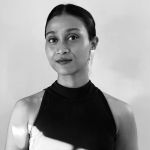

In a sandy, shaded clearing of Crosby Farm Park on a hot, humid July day, sisters Leila and Noelle Awadallah danced without music, accompanied only by the sound of the wind whooshing through giant cottonwoods.
There is no stagy excess, no costumes or makeup. Their bodies contracted and expanded, balancing, twisting and turning, sometimes away from each other, and sometimes towards.
The sisters, who started a dance practice they call Body Watani, were developing a site-specific work. And Crosby Farm Park, near the confluence of the Minnesota and Mississippi rivers, is central to that project.
Watani means homeland in Arabic, with connotations of longing and belonging. It’s a connection to their Palestinian heritage. Their still unnamed work also excavates the idea of homeland, in this case the Dakota land that is their current home.

The work is considering “the ways land was stolen, and the ways people resisted,” Leila said.
Their movement practice is inspired by the land itself, something that grew out of a quest to discover their Palestinian lineage and homeland.
Leila and Noelle, 31 and 29, grew up in South Dakota, born to a Sicilian mother and a Palestinian father. The first thing they remember about their Palestinian identity is not wanting to acknowledge it, even though their last name made it hard to ignore, especially after the Sept. 11 attacks.
Their reluctance to acknowledge their Arab identity was, in part, shaped by their father, who immigrated to America from the West Bank and, like many immigrants, wanted to blend in.

The sisters grew up dancing since elementary school, trained by dancers who stressed expression more than choreography, form and tradition. Leila moved to Minneapolis and graduated with a bachelor of fine arts degree in dance from the University of Minnesota while Noelle studied dance in Columbia College, Chicago. And it is through dance that they began to piece together and celebrate their Palestinian identity.
The Palestinian struggle for land and homeland is long. Its history is complex and laced with displacement, death, and the continued struggle for Palestinian statehood and self-determination in the face of decades-long Israeli occupation.
“When we say we’re Palestinian, we’re sending a ripple into the rejection of ethnic cleansing and erasure,” said Leila, sitting beside Noelle on a branch of a fallen tree at Crosby Farm Park. “It is resonant with Indigenous struggles, that in saying the name, you’re also saying more than just that.”
Leila and Noelle’s Body Watani practice explores the body as the homeland. Their practice is informed by traditional Arabic dance forms like the Palestinian dabke and Egyptian baladi as well as improvisation.
But Leila and Noelle are careful not to call body watani a dance form. For them, it isn’t as much about what it looks like than it is about what it feels like to interrogate and navigate the memories inscribed in the body.
Leila calls the practice “an archaeological dig into the body.”
“If all of this is stored in my body, dancing feels like the most clear path to uncovering and searching and working with what’s been digested over generations,” she said, referring to her grandparents’ history of internal displacement during the Nakba of 1948, and her father’s participation in the resistance against the Israeli occupation.

“Dance and Palestine merged as a way for me to reach towards a place, a language, and a culture that I didn’t have,” said Noelle.
Until 2019, Body Watani was informed only through curiosity and imagination until Leila and Noelle visited their ancestral home in Beit Jala, in the West Bank, in what they describe as both an arrival and a return.
Leila visited her grandparents’ village and danced in the home they had built, now empty. She remembers it viscerally: “It felt like my cells were vibrating and they were all awake. There’s so many threads of truth that we can’t scientifically or logically prove, but the proof is the dancing body.”
There’s many ways in which the sisters’ movement practices differ, but they come together in their shared experiences and identity. The two collaborated in their latest production “After The Last Red Sky”, which premiered last November at The Southern Theatre in Minneapolis. The performance is an ode to the surveilled and drone-infested Palestinian sky, woven with folktales.
Their project was conceptualised before October 2023 when Israel attacked Gaza in retaliation against Hamas’ attack that killed an estimated 1,200 people. Israel’s ongoing offensive, in what experts are calling a genocide, has killed more than 80,000 Palestinians to date.
“Our relationship to the material became, and continues to be even more painful, emotional, charged. How do we talk about what’s the Palestinian sky in this context?” said Leila, looking at Noelle.
“Working on that show became a real-time place to process what we were witnessing, and to comprehend our own bodily reactions,” Noelle added.
For them, parallels between the histories of Palestine and Minnesota are obvious; they see their practice as a thread connecting the two.
“Palestine teaches us how to live on this land, too,” said Leila. “It teaches us how to be in relation with Indigenous land and resist settler colonialism.”

At Crosby Farm Park, Leila and Nolle started their first movement practice as a part of this project, in what they call “land listening.”
Located near the place the Dakota called Bdóte, it is where many Dakota tribes refer to their place of origin. It is also where U.S. soldiers imprisoned over 1,000 Dakota people after the U.S.-Dakota War of 1862.
As they moved under the cottonwoods, the harmony in their partnership is palpable as they read and respond to each other’s movements. It is more akin to listening than watching two people dance. Their practice is alive and it is conscious, as is the land and the homeland to them.
Towards the end of their session, Leila dug her hands into the earth and slowly poured a fistful of soil over Noelle’s arms.
Correction: This story has been updated to clarify the sources that informed Body Watani’s dance practices.